

Bryan University Learning Outcomes Assessment and Research
for Business Programs
News and Updates
- BUS Vertical Program Review 2024 Executive Summary
- PLO 2/3 Cultural Sensitivity and Global Awareness Assessment Results 2023/2024
- PLO 1 Communications Assessment Results 2022/2023
- PLO 4 Quantitative Reasoning Assessment Results 2022/2023
- General Education Assessment: Scientific and Quantitative Reasoning 2022/2023
- Program Review BA Cert Executive Summary 2022
- Bryan University Self Study: NWCCU Candidacy Application
- Bryan University NWCCU Notification of Candidacy Status
Resources
- NWCCU Standards of Accreditation
- BU Learning Outcomes Assessment Framework
- § 668.10 Direct assessment programs.
- Master Curriculum Map
- NILOA Glossary of Assessment Terms
- BU Learner Support Model (the fishbone)
- BU Preparation Wiki for NWCCU Site Visit
Institutional Learning Outcomes Competencies
- Communication
- Global Awareness
- Cultural Sensitivity
- Scientific and Quantitative Reasoning
- Critical analysis and logical thinking
- Problem Solving
- Information literacy
At Bryan University, we need to know if our students are learning. It’s really that simple. Our students take courses, progress from one term to the next, but how do we know whether or not they are learning what they need to know?
The Meaning, Quality, and Integrity of the degree, found in the Degree Qualifications profile (DQP) (Lumina Foundation, 2011, 2021) is one way of thinking about our students and their learning and success in our programs. What do our degrees mean for students, especially in the marketplace? Are our programs high quality and how do we know? Do our degrees stand the test of time, align with best practices and industry standards, and are competitive in the marketplace of ideas? These questions all get to the crux of why we assess learning.
Assessment can “feel” sort of disjointed from our regular day-to-day operations, but in fact, if we consider what our students are doing, why they are here, and what we are trying to do with them, assessment undergirds the entire student journey.
What is assessment and why is it important?
Assessment is the method by which we measure student learning at the program level, which is different from the more granular assignment grading activities within courses. Assessment is defined by the Association of Assessment for Learning in Higher Education as:
“Assessment is an ongoing process aimed at understanding and improving student learning. It involves making our expectations explicit and public; setting appropriate and high standards for learning quality; systematically gathering, analyzing, and interpreting evidence to determine how well performance matches those expectations and standards; and using the resulting information to document, explain, and improve performance.”
Angelo, T.A. (1995). Reassessing and defining assessment. AAHE Bulletin, 48(3): 149.
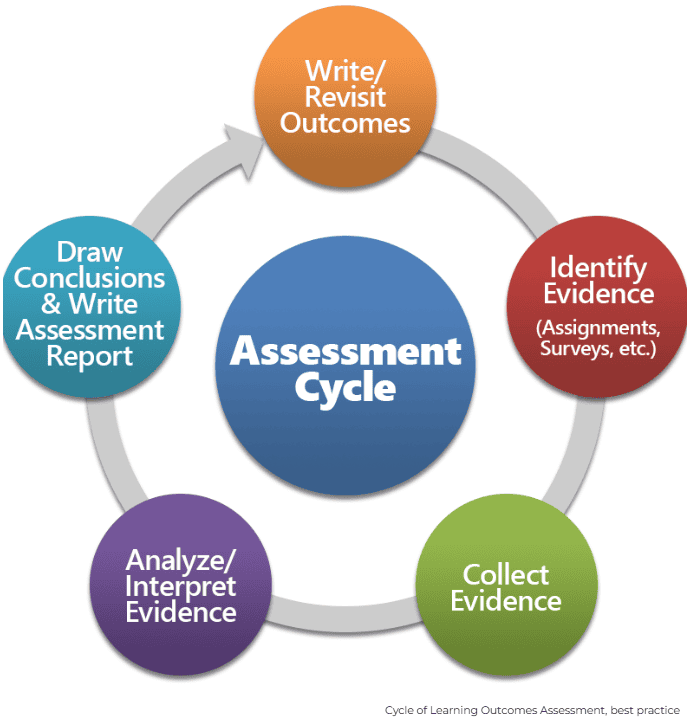
How do we measure student learning and why?
The most effective method, and best practice for measuring our student’s learning is by measuring their skills, knowledge and abilities, which we refer to as Program Learning Outcomes (PLOs). Each program has specific outcomes related to mastery of the relevant skills students should know as graduates. By measuring their skills as they relate to the meaning and quality of the degree, we can filter out the non-cognitive elements of student achievement, and know whether or not our students are learning.
What do accreditors want?
Both ACCSC and NWCCU expect the faculty, as the intellectual and academic owners of our curriculum and degree programs, to measure student learning. There are a lot of ways to do this, but the most widely accepted method of measuring student learning is via LO assessment.
How do we move from compliance to program improvement and why?
By establishing an assessment and program review process cycle of activities, we embed a systematic approach to understanding our students and their learning, as well as use the data from our assessment to improve our programs, thus ensuring the quality and integrity of our degree programs.
Assessment is surely a compliance issue. We are required to assess student learning to maintain our institutional accreditation, continued access to Title IV, and maintain good standing as a quality institution. However, assessment is the most efficient and effective method for the faculty to know whether or not our students are learning and have satisfied the requirements of the degree.
What is the scholarship on learning?
The scholarship on learning is vast, but the literature on assessment supports direct assessment of program learning outcomes as a method of institutional effectiveness and degree profile authentication. By assessing how well our students are learning their degree knowledge, skills, and abilities, better curriculum, design, and pedagogy can be developed to improve our programs. Triangulated with guidance from our Program Advisory Committees (PACs), we can ensure that our programs have meaning and are of high quality.
According to Hurney, et al (2016) assessment of learning outcomes, based on the program learning outcomes, is the best method toward ensuring the scholarly, evidence based practices are disseminated throughout the curriculum. Connecting faculty to the scholarly literature through learning measurement keeps our programs relevant to industry. It is also one of the ways in which we can differentiate not only our distinct programs’ value propositions for students, but also allow us to differentiate levels of appropriate rigor between our stacked approach from certificate to associate degree to bachelor completion degree (Halonen et al, 2022; Swarat, et al, 2017). This is also the same principle related to the degree profile mentioned above, as specialization is a point of distinction (Swarat, et al, 2017).
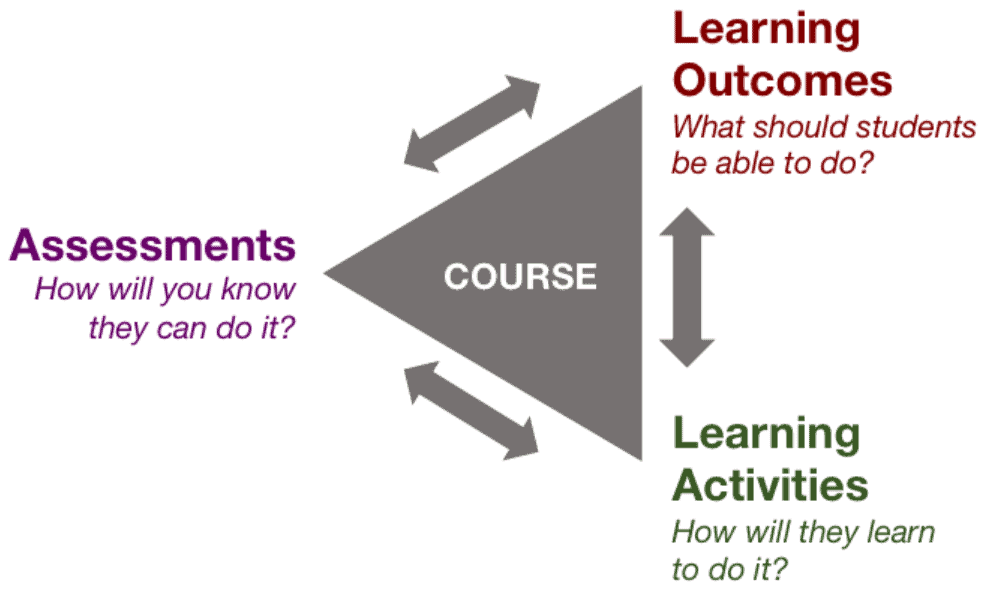
Assessment of learning outcomes also serves as a cycle of improvement of our curriculum (Dressier, 2011). Without having data to help us make decisions about our curriculum, we either end up with curriculum that is stale, or curriculum that is changed that is based on arbitrary wishes rather than best practices within our discipline. In essence, we strengthen our curriculum through designing curriculum that is connected to scholarly evidence and revise it based on aggregate student performance. It is the aggregation of student performance, rather than individual student performance that informs us of the areas and opportunities in our pedagogy and curriculum to better serve our students and their success. When we aggregate our data, we can see where our curriculum needs lie, or updates based on changing landscapes, or areas of poor curriculum design that our students experience.
What is the faculty role in assessing learning?
- Provide assessment workshops throughout the academic year to provide advice on how to assess their program, what to assess, and how to act on the assessment results.
- Program Team Requirements for full time and adjunct faculty
- Participate in at least one program-level outcomes assessment project for the year
- Implement at least one action to improve student learning as suggested by assessment project results
- Identify course-level outcomes that align with program-level outcomes, where applicable
- Revise course- and program-level outcomes, as needed, to ensure that all outcomes are current and assessable
- Participate in the development or revision of a comprehensive plan to assess all applicable program-level outcomes
References
Angelo, T.A. (1995). Reassessing and defining assessment. AAHE Bulletin, 48(3): 149.
Dressier, S., Cedercreutz, K., & Pacheco, A. (2011). Strengthening curriculum through student learning outcome assessment in experiential learning. Journal of Hospitality & Tourism Education, 23(2), 41-47.
Halonen, J. S., Thompson, J. L., Whitlock, K. H., Landrum, R. E., & Frantz, S. (2022). Measuring meaningful learning in introductory psychology: The IPI student learning outcomes.
Hurney, C. A., Brantmeier, E. J., Good, M. R., Harrison, D., & Meixner, C. (2016). The faculty learning outcome assessment framework. The Journal of Faculty Development, 30(2), 69-77.
Swarat, S., Oliver, P. H., Tran, L., Childers, J. G., Tiwari, B., & Babcock, J. L. (2017). How disciplinary differences shape student learning outcome assessment: A case study. AERA Open, 3(1), 2332858417690112.
The Lumina Foundation (2011) Meaning, Quality, and Integrity of the Degree.