Navigating Academic Integrity: AI Use and Plagiarism
Academic Integrity in Student Work

AI tools can support learning but may lead to plagiarism if students misuse them. Whether AI-generated or not, plagiarism occurs when others' work is presented without proper citation. Faculty must address suspected misuse carefully, balancing fairness with academic integrity. Educating students on proper citation and the ethical use of AI helps prevent both unintentional and intentional plagiarism, fostering a respectful learning environment that supports both technology and integrity. This resource page helps faculty navigate academic integrity, focusing on AI use and plagiarism.
Academic Integrity: AI
What is AI?

AI (Artificial Intelligence) refers to the simulation of human intelligence in machines that are programmed to think, learn, and solve problems. These systems can perform tasks such as recognizing speech, making decisions, and interpreting data, often improving their performance over time through experience.
Russell, Stuart J., and Peter Norvig. Artificial Intelligence: A Modern Approach. 4th ed., Pearson, 2020.
What is Bryan's AI Policy?
The ChatGPT or Other AI Tools policy, located in the policy section of the course syllabus and in the University Catalog, outlines important guidelines for the use of ChatGPT or Other AI Tools. Take a moment to read through it and familiarize yourself with the policy to ensure consistent enforcement in all courses
***********
Use of ChatGPT or Other AI Tools Policy states:
Bryan University recognizes the utility of artificial intelligence (AI) tools in both academic settings and as part of our daily lives. In an effort to support a robust learning environment that adapts to changing technologies, guidelines for engaging AI tools, such as ChatGPT, are described here.
Faculty may encourage students to develop their skills in using AI or leverage AI to help students learn about their fields or course content within online courses. This is at the faculty member’s discretion. However, unless otherwise specified by the faculty member, all submissions, whether in draft or final form, to meet course requirements (including a paper, project, exam, computer program, oral presentation, or other work) must either be the student’s own work, or must clearly acknowledge the source. Unless an instructor indicates otherwise, the use of ChatGPT or other AI tools for course assignments is akin to receiving assistance from another person and raises the same concern as work that is not the student’s own. Sanctions fall under those listed in the Code of Conduct.
What to Do if AI Use is Suspected
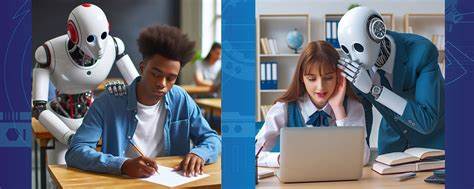
What to do if using advanced plagiarism detection tools:
Assignments, research papers, and other submissions are routinely screened using advanced plagiarism detection tools such as Turnitin, Grammarly, or Copyscape. If a faculty member detects plagiarism or inappropriate use of AI occurred, the faculty member should do the following:
Step 1: The instructor reviews the suspected case to determine if 30% or greater of any portion of the work has the work has inappropriately used AI or been plagiarized.
Step 2: The instructor notifies the Program Director. If an adjunct, submit a Student At-Risk form in Canvas. If full-time, create a case and add the Program Director as a collaborator on the case. The Program Director will provide guidance on the next step.
What to do if you are not using advanced plagiarism detection tools:
If advanced plagiarism detection tools are not used, but you suspect AI use, the faculty member should do the following:
Step 1: Review the submission in detail, focusing on aspects that may suggest AI involvement, such as:
-
Unusual writing style or tone.
-
Sudden shifts in the level of coherence, creativity, or originality.
-
Patterns that seem overly generic or mechanical.
-
Lack of personal insights, reflections, or a specific argument.
-
Repetitive or overly formal language.
Step 2: The instructor notifies the Program Director. If an adjunct, submit a Student At-Risk form in Canvas. If full-time, create a case and add the Program Director as a collaborator on the case. The Program Director will provide guidance on the next step.
How to Talk to Students if AI is Suspected
If you suspect that a student has used AI tools like ChatGPT to complete their assignment or exam, it’s important to approach the situation with clarity, fairness, and professionalism. Beware of falsely accusing students outright, as AI tools can produce false positives.
Here are a few steps to follow:
Start with an Open Conversation: Approach the student with a neutral, non-accusatory tone. For example:
“I noticed some inconsistencies in your work that are unusual compared to your previous submissions. Can you walk me through your process for completing this assignment?”
Ask Clarifying Questions: If you suspect AI was involved, ask the student to explain specific parts of their work, particularly any areas that seem inconsistent with their typical performance or writing style.
“Can you explain this section in more detail? It seems different from what you’ve written before.”
Focus on Learning and Integrity: Reinforce the importance of independent thought and learning in academic settings. Encourage students to see value in developing their own work and ideas, even in an age of AI.
“While AI tools can be useful for research, your work should reflect your own understanding and learning. Let’s discuss how we can ensure your assignments are truly your own.”
Why Balance Matters with Your Approach
When addressing suspected academic dishonesty related to AI use, it’s important to approach the situation with caution and fairness.
Avoiding Unfair Accusations: Many students use AI tools for legitimate purposes, like brainstorming or improving writing. Assuming they cheated based on AI use can unfairly penalize them.
Ensuring Fairness: AI detection tools can be inaccurate, leading to false positives or missing subtle AI use. A balanced approach is needed instead of relying solely on technology.
Fostering Trust: Trust is key in the teacher-student relationship. Not assuming cheating helps create an environment where students feel comfortable asking about AI use and academic integrity.
Promoting a Growth Mindset: Students may not fully understand AI boundaries. Offering guidance rather than immediate discipline helps them learn about academic integrity.
Engaging in Open Dialogue: Approach students with an open mind. A conversation can clarify misunderstandings and provide insight into their work process, helping you assess if there’s cause for concern.
The Downside of AI Detection Tools
While AI detection tools can help identify whether a student’s work has been influenced by AI, they are not perfect and can have limitations. It’s important to be aware of these potential downsides:
False Positives: AI detection tools may incorrectly flag a student’s work as AI-generated, even if it is entirely original. This can lead to unnecessary stress and confusion for students who are being falsely accused.
False Negatives: These tools may fail to detect instances where AI has been used subtly or indirectly, potentially allowing students to get away with academic dishonesty.
Limited Context: Detection tools typically look for patterns in writing style or inconsistencies but may not fully understand the context of a student’s work, making them imperfect for definitive conclusions.
Overreliance on Tools: Faculty should avoid relying exclusively on AI detection tools to judge academic integrity. Instead, combine the tools with thoughtful conversation, as mentioned earlier, and other assessment techniques.
Academic Integrity: Plagiarism
What is Plagiarism?

“Plagiarism is the act of taking someone else’s work, ideas, or intellectual property and presenting them as your own, without proper acknowledgment.” (Purdue OWL, 2020) This can include copying text, images, or research findings, as well as failing to cite sources correctly in academic, creative, or professional contexts. Plagiarism is considered unethical and can lead to serious consequences, such as academic penalties or legal action.
“What is Plagiarism?” Purdue Online Writing Lab (OWL), Purdue University, https://owl.purdue.edu/owl/avoiding_plagiarism/index.html.
What is Bryan's Academic Dishonesty Policy?
The Academic Dishonesty Policy, located in the policy section of the course syllabus, outlines important guidelines for maintaining academic integrity and the consequences for engaging in dishonest behaviors, ensuring that all students understand the expectations for completing their work independently and honestly. Take a moment to read through it and familiarize yourself with the policy to ensure consistent enforcement in all courses
*******
Academic Dishonesty Policy states:
Learning occurs through independently completing course requirements (Learn Its, assignments, quizzes, and exams) and expressing thoughts in your own words.
Academic dishonesty is an action that relates to cheating or other completion of work that lacks integrity. Examples of academic dishonesty include buying, stealing, copying, or borrowing someone else’s work; having someone write your work or complete your test for you, using another person’s test answers, and plagiarism. Plagiarism includes passing someone else’s work or ideas as your own without crediting the original source of the work/idea.
Students who engage in academic dishonesty may receive the following penalties:
A failing grade on the work in question (which cannot be made up).
The student may be placed on academic probation.
Multiple occurrences of academic dishonesty may result in termination from Bryan University.
How to Read Turnitin Scores
Turnitin is a widely-used tool for detecting potential plagiarism and ensuring academic integrity by comparing student submissions to a vast database of academic sources, internet content, and previously submitted papers. The Turnitin score, known as the Similarity Index, helps faculty identify how much of a student’s work overlaps with existing sources. Here’s a guide to understanding and interpreting Turnitin scores:
Understanding the Similarity Index
The Similarity Index is expressed as a percentage that represents the portion of the submitted document that matches content from Turnitin’s database. For example, if a paper has a Similarity Index of 25%, it means that 25% of the paper contains text that matches sources in Turnitin’s database.Interpreting the Percentage
The percentage alone does not determine whether plagiarism has occurred; it is merely an indicator of similarity. The key is in analyzing what the matches are and how they appear in the context of the paper. Here’s a general guide to interpreting different score ranges:0% to 10%: Low similarity. This usually indicates a small amount of matching text, possibly due to commonly used phrases, references, or general knowledge.
10% to 30%: Moderate similarity. This range might suggest that the student has used some sources, but not necessarily inappropriately. It’s worth checking to see if the matches are properly cited or if the content is paraphrased.
30% to 50%: High similarity. This range indicates that a significant portion of the work matches existing sources. Further investigation is needed to see if the student has paraphrased or cited the material correctly.
Above 50%: Very high similarity. This is a red flag for potential plagiarism and requires immediate attention. In such cases, it’s crucial to carefully review the matched sources to determine whether the student has copied text directly without proper citation or made minimal changes to the original content.
Examining the Match Overview
After viewing the similarity score, click on the score itself to access a detailed report of the matches. This report highlights the exact text from the student’s paper that matches external sources. It will show:The percentage of similarity.
A list of sources that contain matching text.
A color-coded system to help identify which parts of the text match specific sources.
Originality and citation status: The report will indicate if the matching text is properly quoted and cited, which can help you determine if the similarity is a legitimate case of proper academic practice.
Reviewing the Matches
Not all matches represent plagiarism. Commonly matched content includes:Quoted text that is properly cited.
References or bibliographies that match exact wording but are not plagiarized.
Technical or commonly used phrases that don’t require citation.
It’s important to carefully distinguish between correctly cited material and potential instances of plagiarism. Pay close attention to:
Whether direct quotes are enclosed in quotation marks.
If paraphrased material is sufficiently reworded and attributed to the original source.
Whether common phrases or references are being flagged unnecessarily.
Consider the Context
Always keep in mind that a high Similarity Index does not automatically indicate intentional plagiarism. Some papers may have a high similarity due to the use of common academic phrases or unavoidable matches (e.g., quotes, technical terms, or shared ideas). Context is key—consider whether the student has properly acknowledged the sources, whether they’ve used proper citation methods, and whether the matches are integral to their argument or background information.Final Judgment
After reviewing the Turnitin report, use your academic judgment to determine whether plagiarism has occurred. A high similarity score should prompt further investigation, but the context, citation practices, and use of the material are the ultimate factors in determining academic integrity.
By understanding how to read and analyze Turnitin scores, you can more effectively assess whether a student has plagiarized and ensure fair, informed decisions in upholding academic integrity.
How to Check for Plagiarism Without Using Turnitin
While Turnitin is a popular tool for detecting plagiarism, there are several other methods you can use to check for plagiarism manually or with free tools. Here are some effective strategies to identify potential plagiarism without relying on Turnitin:
1. Search for Suspicious Phrases or Sentences
One of the easiest and quickest ways to check for plagiarism is by searching for phrases or sentences from the student’s work using a search engine like Google.
How to do it: Copy a unique sentence or phrase from the paper, enclose it in quotation marks, and paste it into a search engine.
What to look for: If the sentence or phrase appears in exact form elsewhere on the web, it might indicate that the student has copied it from another source.
2. Use Free Plagiarism Detection Tools
Grammarly: The free version of Grammarly offers a plagiarism checking tool that compares the submitted text against billions of web pages, academic papers, and other online content. While the premium version offers a more detailed analysis, the free version still provides a basic level of plagiarism detection, highlighting potential matches in the student’s work.
3. Check for Inconsistent Writing Styles
If a student’s paper has noticeable shifts in tone, vocabulary, or writing style, it may be an indicator of plagiarism. Another potential indicator is if the text is in a different size, font or color.
What to look for: Look for sections that don’t align with the rest of the paper in terms of fluency, structure, or complexity. For example, if one paragraph uses complex vocabulary while another is simpler or has a different tone, it might suggest the student copied part of the paper from another source.
What to do if Plagiarism is Suspected
Plagiarism includes passing someone else’s work or ideas as your own without crediting the original source of the work/idea. Bryan University takes plagiarism seriously but also understands that students may not fully understand plagiarism. Because of the implications of an inaccurate accusation, contact your Program Director for further direction on the appropriate steps to take. If an adjunct, submit a Student At-Risk form in Canvas. If full-time, create a case and add the Program Director as a collaborator on the case.
Academic Integrity Resources
Student Support Resources
Encourage students to take advantage of the Student Resource Center at Bryan University. The Student Resource Center is here to support students in navigating the ethical use of AI and maintaining high academic standards. Additionally, the center provides valuable resources on preventing and addressing plagiarism, helping students understand the importance of originality in their work. By utilizing these resources, students can enhance their academic integrity, ensure proper citation practices, and gain a deeper understanding of how to use AI tools responsibly in their coursework.
Encourage students to use the Using AI Responsibly located in the Student Resource Center. Students will learn the basics of AI and be provided with additional tools and resources.
The Ethical AI Use Checklist for Students is a practical guide designed to help students navigate the responsible use of AI tools in their academic work. This checklist provides clear, actionable steps to ensure that students maintain academic integrity, avoid plagiarism, and properly cite sources when using AI. Faculty can share this resource to encourage students to use AI ethically and responsibly, fostering a deeper understanding of how to integrate technology into their learning without compromising their academic standards,
Additional Faculty Resources
***Explore the Using AI Responsibly located in the Student Resource Center. This will provide valuable insight into what tools and information students are provided with.
Here are some additional AI and academic integrity resources to explore:
Could ChatGPT Prompt a New Golden Age in Higher Education?
AI-Detectors Biased Against Non-Native English Writers
Grammarly is AI– We’ve Been Using it All Along
10 Best Undetectable AI Tools to Bypass AI Detection (Free & Paid)
Academic Podcast Picks: Recommended Episodes
Want to learn more about AI and It’s impact on Higher Education. Check out the following podcast.
Autumm Caines discusses chatGPT and good intentions in higher ed on episode 452
We all want to ensure our students’ work is authentic, and some of the strategies for doing so involve implementing the good practices we’re likely familiar with: assignment redesigns
Learning to Teach Better episode 111 with Marc Watkins, Academic Innovation Fellow, Lecturer of Writing and Rhetoric, and Director of the AI Summer Institute for Teachers of Writing at the University of Mississippi as we discuss AI in Education. June 2024
Autumm Caines + Maya Barak help us with expanding our collective understanding of generative artificial intelligence (AI) on episode 501
Stein Brunvand talks about equipping educators to navigate artificial intelligence (AI) on episode 498
Lindsay Doukopoulos talks about teaching with artificial intelligence on episode 489 https://teachinginhighered.com/podcast/teaching-with-artificial-intelligence/
Derek Bruff shares about assignment makeovers in the AI age on episode 481 https://teachinginhighered.com/podcast/assignment-makeovers-in-the-ai-age/
Lance Eaton + Stead Fast have a dialog about their perspectives on artificial intelligence on episode 472
This American Life tackles how humans encounter non-human intelligences of various kinds and try to make sense of them: Greetings, People Of Earth
Maria Andersen shares about designing courses in an age of artificial intelligence (AI) on episode 469
Copyright 2025 | Bryan University | 350 West Washington Street, Tempe, AZ 85281

Copyright 2025 | Bryan University | 350 West Washington Street, Tempe, AZ 85281